
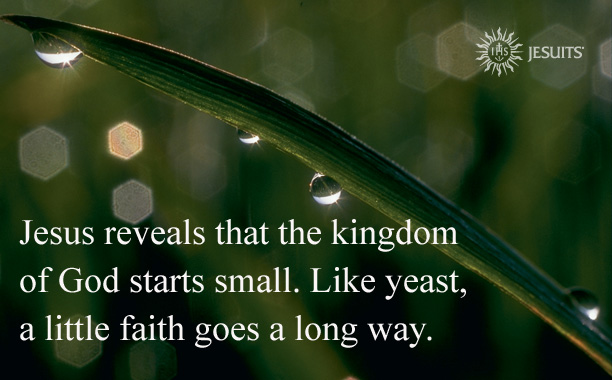
Luke 13: 18-21
Jesus said therefore, “What is the kingdom of God like? And to what should I compare it? It is like a mustard seed that someone took and sowed in the garden; it grew and became a tree, and the birds of the air made nests in its branches.”
And again he said, “To what should I compare the kingdom of God? It is like yeast that a woman took and mixed in with three measures of flour until all of it was leavened.”
New Revised Standard Version, copyright 1989, by the National Council of the Churches of Christ in the United States of America. Used by permission. All rights reserved. USCCB approved.
What is the Kingdom of God Like to You?
When I read these simple parables of Jesus, I wonder to what he might compare the Kingdom of God if he were teaching and preaching today.
“The Kingdom of God is like learning to ride a bike, which begins slowly and with struggle, but soon transports us to new places and opens our horizons.”
“The Kingdom of God is like a coffee bean. Though one bean alone is hard and bitter, many beans together, once ground and percolated, produce energy, life, and connection.”
“The Kingdom of God is like graffiti. Resisting oppression and despised by many, it enlivens even the darkest corners with the peculiar beauty of its very being, saying, ‘I am here, and that is enough.’”
What is the Kingdom of God like to you? To what would you compare it? Try to notice today, as Jesus did, what around you speaks of the goodness of God’s Kingdom already present here and now.
—Brian Martindale, SJ, is a Jesuit scholastic of the Midwest Province serving as a campus minister and math teacher at Cristo Rey Jesuit High School – Twin Cities.
Prayer
I find you, Lord, in all Things and in all
my fellow creatures, pulsing with your life;
as a tiny seed you sleep in what is small
and in the vast you vastly yield yourself.
The wondrous game that power plays with Things
is to move in such submission through the world:
groping in roots and growing thick in trunks
and in treetops like a rising from the dead.
—Rainer Maria Rilke